Records, Evidence, and Research
By Jeffrey Morrill
October 22, 2026
Abstract
Artificial intelligence (AI) offers genealogists more than general advice when it can work with the records, notes, and unresolved questions of a particular investigation. This article argues that AI has inverted the economics of research: discovery is now cheap, and verification has become the scarce resource. Drawing on genealogical standards and on studies of research practice, document recognition, and language models, it distinguishes access to information from the judgment needed to use it as evidence. A worked example illustrates how discoveries can become proposed changes without passing directly into the family tree. The article presents a method rather than an evaluation of software. Its central claim is that AI’s value to the genealogist lies not in what it can generate, but in what it helps the researcher independently verify.
Keywords: artificial intelligence; genealogy; historical records; evidence; research methods
1. The Research Task
Much genealogical work takes place between finding a record and knowing what to make of it. A familiar name turns up in the wrong county’s census; a death certificate names parents no earlier record mentions; a county history and an online tree tell the same persuasive story because one copied the other. The difficulty is not always a shortage of information. It is deciding how the surviving information bears on the question.
This is the setting in which AI may become useful. General advice can explain what a quitclaim deed is or where Vermont vital records are kept, but it leaves the researcher to supply the connections that make a particular investigation intelligible. An AI system with access to that investigation can participate in a more demanding exchange: comparing interpretations, following a lead, and helping explain why a conclusion remains uncertain. The relevant question is therefore not simply whether AI can produce genealogical information, but how it can contribute to the work by which information becomes a defensible conclusion.
The Genealogical Proof Standard provides the framework for answering that question: reasonably exhaustive research, complete and accurate citations, analysis and correlation, resolution of conflicts, and a written conclusion.[1] These requirements concern the relationship between evidence and conclusions, regardless of the tools used. AI assistance is valuable to the extent that it helps researchers meet them; the appearance of a finished answer is not a substitute.
One change in circumstance frames everything that follows. For most of genealogy’s history, finding was the bottleneck: a parish register meant a letter or a journey, a census search meant a reel of microfilm read frame by frame, and checking a claim cost little beside producing one. Where records are digitized — and more are every year — AI makes production nearly free: search results, transcriptions, narratives, and citations arrive faster than anyone can read them. The scarce resource is now verification. Research on the models themselves reaches the same conclusion from the other side. Checking the machine’s output by hand does not scale, as a NeurIPS 2025 study of machine verification observes:[11]
“humans could judge LM responses but manual evaluation is often expensive, noisy, and difficult to scale.”
And automating the checking does not make it cheap — the same study reports that reliably verifying a model’s output costs ten to over a hundred times the computation of producing it. Verification is now the harder and more expensive problem, for machines as for genealogists. A research method is therefore good to the degree that it makes claims cheap to check rather than cheap to produce; AI’s value to the genealogist lies not in what it can generate, but in what it helps the researcher independently verify.
In this article, an assistant responds to the researcher’s questions and requests; an agent also uses tools to carry out a delegated task. An agent may search collections, examine documents, and choose a next step within limits set by the researcher. This distinction concerns capacity and autonomy, not trustworthiness. The article proposes a method, not a measured gain in speed or accuracy.
2. Discussion of Existing Research
An assistant used out of the box offers little help with a specific family problem when it lacks the researcher’s data. It may explain a census or suggest a website, yet it cannot reconstruct years of investigation from a surname and a question. Nor can it know an unrecorded reason for rejecting a possible parent — though once that reason is supplied, the discussion can move beyond proposing the same candidate again.
Access to a tree is a beginning, but a family-tree file is a cache of conclusions from which the derivations have been discarded. That deficiency was always there; it went unnoticed because the researcher carried the derivations in memory, and the file never had to speak for itself. The first collaborator to arrive without that memory exposes it. When an assistant proposes the candidate father the researcher rejected a decade ago, or recommends the census search exhausted long since, the assistant is not missing context — the file is. The preparation AI seems to demand (source extracts, logs, recorded reasons for rejecting a candidate) is nothing new: it is the written-conclusion standard genealogy has always professed, finally enforced by circumstance. A conclusion that cannot be re-derived from the file cannot be independently verified — by an assistant today or by another researcher tomorrow. With that material restored, the researcher can ask a different kind of question: not merely “Who were this person’s parents?” but “What supports the parents recorded here, and what have we not yet tested?”
Consider two census entries assigned to one person. An assistant can bring dates, places, household members, and occupations into a comparison; the researcher can then challenge the proposed interpretation. Does a change of occupation explain the difference — a farmer in 1850, a machinist in 1860 — or are two people being combined? Which record would help distinguish those possibilities? The discussion is useful because it turns an apparently settled entry into an argument that can be examined. For an experienced genealogist, that may mean revisiting an assumption; for a beginner, it can reveal why a matching name is only the start of identification.
A 2025 study gives this educational role a research context. Fei Shan and Kurt Luther, human-computer interaction researchers at Virginia Tech, interviewed twenty genealogists — ten experienced professionals and ten newcomers — about how they research, collaborate, and learn.[4] The two groups differed in how they planned searches and judged evidence, and the authors call for technology that teaches those research choices rather than merely returns records. Their suggestion that language models might support such learning remains a proposal, not a result, but it points to a lasting distinction: help that explains a research decision outlasts help that supplies an answer without its basis.
The same lesson appears in the research on language models themselves. In 2020, Patrick Lewis and colleagues introduced what is now called retrieval-augmented generation: instead of answering from its training memory alone, the model first retrieves relevant passages from an external document collection and builds its answer from them.[7] On question-answering tests, the retrieval-backed answers were measurably more accurate. For genealogy, the principle should be absolute: no fact is taken from the model’s memory. The model is the courier, never the witness — it finds and reads records, and every fact traces to a record the researcher can examine. Genealogy then adds a demand of its own: retrieving what a source says does not establish whether its informant knew the facts, whether it repeats another account, or whether it concerns the right family. Access makes an informed discussion possible; evidence analysis determines what that discussion can justify.
3. Work on a Research Gap
Every genealogist has a brick wall: the great-great-grandmother with no maiden name, the ancestor who appears in the 1850 census with no trace of his parents. Asking an agent to “find more about Sarah” invites it to bring back whatever is easiest to find. The question must be asked the way a researcher would ask it — say, Sarah, wife of Amos Chase of Gilmanton, born about 1812 in New Hampshire: who were her parents? The name, place, period, and the evidence already in hand give the search a target, and give the researcher a way to judge what comes back.
A research plan is nothing more exotic than the to-do list in the back of the binder, with the reasons written down: check the Belknap County probate index, because if Sarah’s father died owning land, his estate file could name her as Sarah Chase; revisit the 1850 household two doors away, because the older woman there shares Sarah’s birthplace. The reasons are the working part — the planning standards in Genealogy Standards ask for sources chosen for stated reasons, not a list of websites to visit.[1] Write the list before the search. A list written afterward tends to justify whatever the search happened to find, and an agent will justify its findings fluently. Written first, it records what the researcher meant to look for and why; when a find redirects the search, the change and its reason go on the list too. That record, not the list’s permanence, is the standard for judging both a promising result and a disappointing one.
An agent’s greater opportunity lies in working through such a list and following where it leads. The plan is a starting point, not a fence: a marriage notice may name a sibling whose household points to another county, and that county’s records may hold the will the first search never reached. The work circles — review what is known, pick the next source, read it, compare, revise the list — and the researcher can discuss each turn with the agent instead of issuing a disconnected series of searches.
The limits of access remain part of the result. An index entry, a catalog description, and an examined document are different accomplishments, even when each points toward the same record; some collections require payment, permission, or a visit to an archive. An agent that reports only what it found online may present an apparent completeness that conceals the most important unfinished work. It can help organize the investigation, but it cannot certify that the research is reasonably exhaustive.
A search that finds nothing proves, by itself, almost nothing: the collection may not cover the right place or years, and the record may hide behind a misspelling. Absence carries weight only in a record examined whole, where the person was expected to appear — a son missing from his father’s will — and even then the researcher must explain why.[2] Failed searches are still worth logging: the log prevents repeated dead ends, shows what to re-run when a collection grows, and, since no one watched the agent work, is the only evidence of how hard it actually looked. The log is working material, not a citation: it never appears in the tree or on its published pages. Its reader is the reviewer — in this method another AI agent, described below — who sees it before any claim is accepted.
4. Claims and Evidence
Finding more material does not necessarily strengthen a conclusion. Another person’s tree may suggest a relationship, but an unsupported entry does not reveal whether its author researched it carefully, guessed, or copied an error. If twenty trees repeat that entry, their agreement may represent one unsupported assertion rather than twenty independent judgments. An agent that gathers agreement without tracing its origins can make a weak claim look well established — the problem is older than AI, but AI gives the repeated claim a fresh, persuasive voice.
Mills’s distinction between source, information, and evidence provides a way to resist that confusion.[2] The source is the record or work being consulted; information is what it communicates; evidence is the bearing of that information on a research question. An original register, a derivative index, and an authored family history have different origins. Within any one of them, information may be primary, secondary, or of undetermined origin, while its contribution to a particular question may be direct, indirect, or negative. These are separate analytical questions, not a single scale on which a document receives a good or bad mark.
A death certificate shows why the separation matters: its informant may know the death date through direct experience yet know the parents’ names only from family accounts, so a statement that answers a parentage question directly may still rest on secondary information. The researcher weighs the informant’s knowledge, the circumstances of the report, and its relation to other evidence.
The reach of that framework is the surprise. An AI’s statement is itself a source, and Mills’s categories classify it without modification: an authored work, conveying information of undetermined origin, carrying no evidentiary weight until traced to something that does. While other disciplines scramble to construct trust frameworks for AI, genealogy already owns one — a long-built apparatus designed precisely for confident informants of unknown knowledge: the talkative neighbor on the death certificate, the county history, the undocumented tree. A language model is a very fast author of derivative works, and the discipline has always known what to do with those. Seen this way, the twenty copied trees and the fabricated citation (Section 6) yield to one remedy: no assertion counts until it is traced to a source that exists and says what is claimed.
For AI assistance, the practical task is to keep those distinctions visible as material is summarized and compared. A source extract should remain distinguishable from the agent’s interpretation, and an interpretation from the conclusion eventually entered in the tree. Otherwise a qualification erodes at each retelling: “probably her sister, judging by age and household” becomes “her sister” in the summary, and a fact in the tree.
The same discipline applies to agreement and conflict. A death date on a memorial website and the same date in an online tree are not two accounts if both copied one transcription, and a conflicting date cannot simply be omitted because the rest of the story fits. Standards for independence, correlation, and conflict resolution require an explanation of why the evidence supports one conclusion rather than another.[1] An assistant’s contribution should make that explanation easier to examine. Producing a smoother narrative is worthwhile only if the uncertainty and disagreement remain available to the reader: a conclusion that can only be believed, not verified, is testimony rather than research.
5. Document Images and Handwriting
The distinction between source and interpretation begins before a document’s contents reach the conversation. A database index selects from a record, often omitting witnesses, marginal notes, or qualifying phrases; machine-generated text adds another reading between document and researcher. Access to the image therefore changes more than the amount of information available. It lets researcher and assistant question the reading itself: whether the clerk wrote Dunham or Durham, whether a marginal note belongs to this entry or the one above, whether the family two lines down is kin.
So does the current generation of agents actually read handwriting — cursive included? Yes, and better than most genealogists expect. Specialist systems such as Transkribus first made archival manuscripts machine-readable at scale.[5] General multimodal models have now matched them on ordinary hands: Humphries and colleagues, testing models from OpenAI, Anthropic, and Google on eighteenth- and nineteenth-century English manuscripts, measured character error rates of roughly six percent (better than the specialist software), falling below two percent when a model was then used to correct the first transcription.[9] Spina’s earlier work points the same way: ChatGPT usefully, if imperfectly, standardized text already transcribed from 366 historical letters.[6] An agent reading a legible cursive register produces a genuinely strong draft, not an approximation.
The trouble is where the remaining errors fall. A model recovers an ordinary word from the sentence around it, but names, dates, and ages have the least context on the page — so that is where it guesses, and it guesses fluently, writing a plausible name rather than flagging an unreadable one. At a six percent character error rate, roughly a third of seven-letter surnames carry at least one wrong character; and the measured results come from English prose pages, while faded ink, cramped census columns, and tables all do worse. Phelps read as Phipps sends the surname search astray; an omitted “Jr.” merges a father and his son.
None of this is a new problem. Clerks had bad days and worse penmanship, and a careful genealogist facing an unreadable word compares the clerk’s letterforms elsewhere on the page, asks another reader, and transcribes what stays uncertain as uncertain — “Du[?]ham.” The machine will do none of this. It hands over a clean “Durham,” unbracketed, with no sign that the pen stroke was ambiguous, and no setting changes that. The practical mitigation is agreement among independent records: a reading that matches the same family’s marriage record and gravestone can be trusted; a reading no other record supports remains a lead, however clearly the model printed it. Translation needs the same discipline — keep the original text beside the translation so another researcher can check the interpretation rather than inherit an invisible guess.
6. Identity and Review
Even an accurately read document may concern the wrong person, because names repeat. A town founded by two Sanborn brothers will hold, three generations later, several John Sanborns at once — first cousins named for the same grandfather, an uncle and his nephew, or men not related at all. A record that says only “John Sanborn of Grafton County, died 1871” could belong to any of them. A shared name, birth year, and town establish a candidate, not an identity; identity is a conclusion reached by comparing spouses, children, occupations, residences, and associates across records.
How well an agent handles this depends on the shape of the study. A single-surname study has a built-in advantage: its tree tries to hold every recorded bearer of the name, so one check can score every known rival — in one case from the project described below, 448 candidates in a single pass, the strongest rival being the subject’s own father. An ancestry study, working backward from a living person, holds only the direct lines, so the same-name men of the county are precisely the people not in the file; the fix is to instruct the agent to run a short same-name search in the locality and period before accepting an identification. In either study, the rival who left no record remains the researcher’s problem.
Review should ask why the preferred identification fits, why rivals fail, and what evidence could change the answer. A second agent searching the same archives will find the same records and build nearly the same proposal; its agreement is convergence, not confirmation. The useful arrangement is antagonistic: one agent whose only job is to search the archives and build the proposal, and a second whose only job is to judge it — weighing the evidence as recorded rather than re-running the search, free to refuse, and given the strongest judgment available. The searcher wants to succeed; the judge earns nothing by agreeing. If verification is the scarce resource, that is where the expertise belongs.
There is a prior question: does the cited source exist at all? A model asked to produce a citation from memory can invent one, plausible in every detail — Walters and Wilder documented such fabrications in ChatGPT-generated literature reviews.[8] The protection is to deny citations that origin. Here a citation is never composed from memory: it is copied, with its verbatim extract, in the same step that opened the record, and it carries a locator — a URL, film number, or volume and page — that anyone can follow. The judge’s routine check is that each claimed fact matches the captured extract; it does not re-fetch every record. But once per proposal it verifies one randomly chosen citation against the source itself — a spot check that exists because a citation nobody ever re-reads is a citation someone could invent. A fabricated citation is the gravest finding a review can make: every claim resting on it is denied and the work stops for the researcher. A genuine record attached to the wrong person is the harder case — which is why the identity questions above still matter.
The same obligations govern written reports and family histories: fluency gives no license to supply undocumented speech, feelings, motives, or events, and removing one erroneous sentence does not repair the conclusion built upon it. Review must follow the reasoning far enough to determine what else changes when a claim is withdrawn.
7. Access to Tools
A language model and a database are good at opposite things. The model excels at judgment — reading a record, weighing an informant, deciding whether two entries describe one person. It is unreliable at exactly what software does perfectly: mechanical bookkeeping. An agent editing a GEDCOM file (the standard format for family-tree data) by hand must keep thousands of cross-references intact and change only what it means to change; one slipped record pointer corrupts the file, and fluency is no defense against a typo. The remedy is a strict division of labor: give the mechanical work to software built for it, and spend the model on the judgment it is actually good at.
The Model Context Protocol (MCP) is one open standard for arranging this.[3] An MCP server is a program that offers an AI application a set of named tools, each a defined operation with declared inputs and outputs — look up a person, compute an age, draft an edit. The server may run on the researcher’s own computer or remotely; the agent calls the tools during its work and reads their results, much as it reads a web page. The researcher decides which servers to connect and what each may touch, so every capability the agent gains has a bounded, inspectable reach. No other mechanism extends an out-of-the-box agent this way; as the first peer-reviewed study of the protocol puts it:[12]
“MCP extends beyond passive information retrieval by providing a standardized protocol for both retrieval and action, allowing AI systems to combine knowledge access with secure tool execution under a unified framework.”
GedFire is one such server: a software toolkit that reads and edits GEDCOM family-tree files, used in the project described below.[10] Its tools fall into a few families: lookups that find people, families, and sources in the tree and return whole records; identity checks that score a name and its hints against every candidate, or match an entire document — a census household, an obituary — against the tree’s families; date arithmetic and plausibility checks that catch a death recorded before a birth; and changeset tools that draft, validate, and finally apply exact edits. The agent never writes to the file. It asks for a drafted edit, reads the result, and judges.
The boundary works in both directions. Permission to read does not include permission to change — a read-only mode blocks edits while allowing drafts and reports — and access to the family-tree file does not confer access to a subscription archive. Above all, these are mechanical controls, not judgments about historical truth: the software can detect a broken record link while accepting a well-formed marriage that joins the wrong couple. Evidence review must stand apart from file validation — the distinction the next section builds into a procedure.
8. From Discovery to an Approved Change
This section is a working example rather than a general claim. The investigation used Claude Code, a commercial agent environment; GedFire’s MCP server, which did all the reading and writing of the family-tree file; a collection of skills — written instructions that tell the agent how to carry out each kind of task, from searching a record collection to arguing an identification; and web access to a variety of online genealogy databases. The process begins by identifying a gap: a question the tree cannot yet answer — pinning down a birth or death, finding a spouse, finding children, finding parents. Searching the databases — the harvest — produces findings, one document per discovery, each holding the source reference, a verbatim extract, and the claims to be assessed. Each finding is then correlated with the tree: the agent decides whom the record concerns — the identity questions of Section 6 — and whether it enriches a person already present or adds a new one. This is the step genealogy’s standards call analysis and correlation, and nothing downstream is sounder than the correlation it rests on. From correlated findings, GedFire drafts a changeset: literally a list of proposed modifications to the family tree, not yet applied. Changesets are packaged into a proposal, a document that argues the case for each change and is accepted or denied at review. Two ground rules govern the harvest: the agent searches only under the researcher’s own logins and takes a site’s refusal as final; and findings record living people in full, with privacy enforced at publication, not at capture.
The split between harvest and review is antagonistic by design. Harvester and reviewer are separate subagents, launched with different prompts and different skills, neither seeing the other’s reasoning. The harvester is dispatched to close a gap and wants to succeed — asking it to judge its own case is asking it to grade its own homework. The reviewer closes no gaps, earns nothing by agreeing, and rules by accepting or denying. The documents are the terms of engagement: the harvester commits its entire case to paper — findings, changeset, proposal — and the reviewer rules only on what the paper shows. Nothing touches the tree until the case survives a reader whose only job is to find its flaws.
Review and approval could rest with the human researcher — nothing in the design requires a machine judge. This project delegates the role to a subagent supplied with skills that encode the rules of genealogical evidence from Section 4, so the reviewer applies nothing novel. For each proposed change it asks the discipline’s own questions of the proposal, its changeset, and the findings beneath them — is the source original or derivative, could the informant know the fact, is each citation graded no higher than its record supports, do independent records corroborate, and does the identity argument exclude the rivals? The grade has a home in the file format itself: GEDCOM’s QUAY (quality) value, a 0-to-3 assessment recorded on each citation, from unreliable or estimated at 0 up to direct, primary evidence at 3. That small field is useful here because it makes the evidence grading of Section 4 a written, checkable part of every proposed edit — a grade the reviewer can contest — rather than an opinion held in the researcher’s head. The AI is new; the standard it enforces is not.
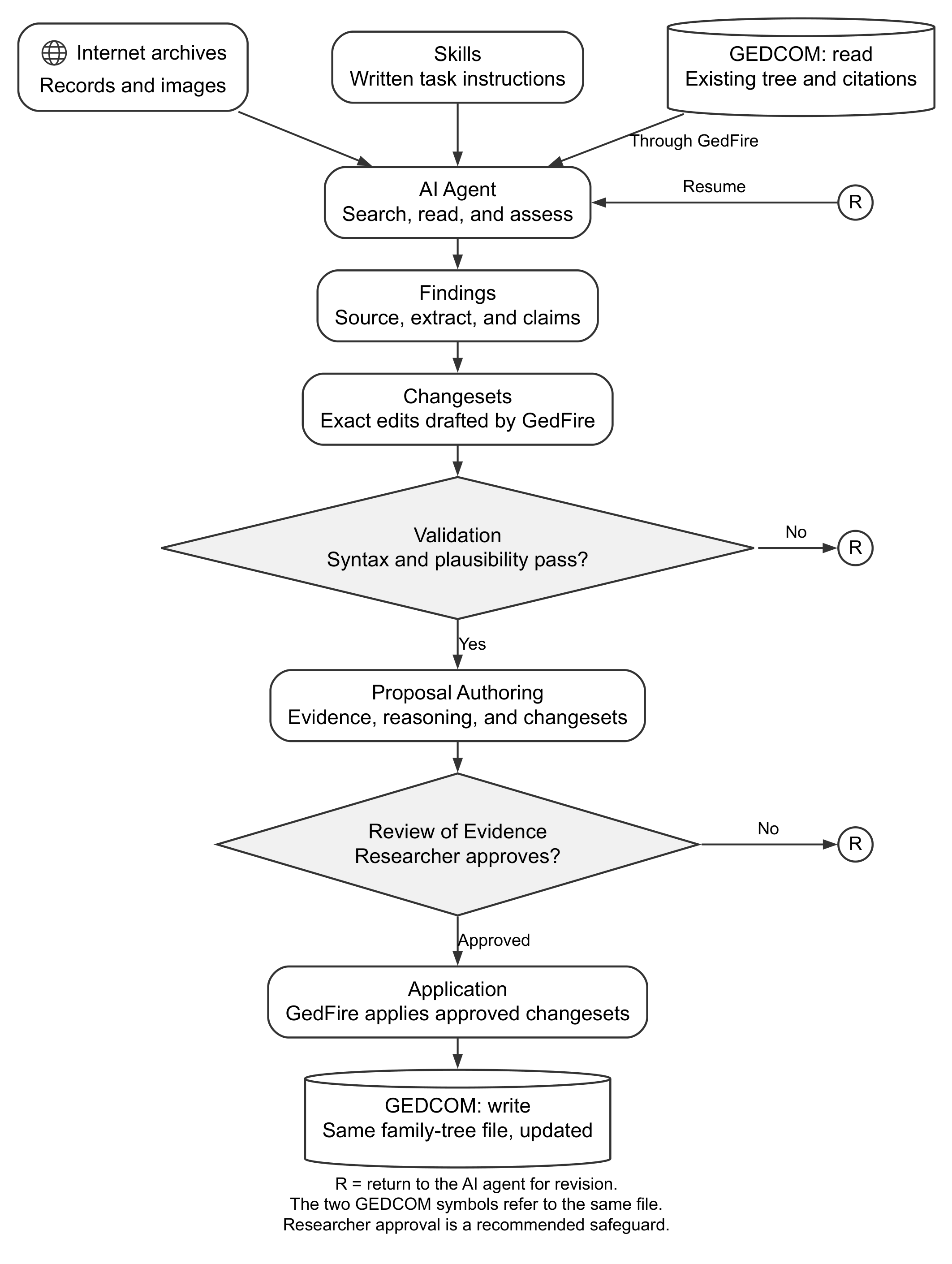
Figure 1. Information flow in the research process. Diamonds mark decisions; circles marked R return work to the AI agent for revision. The two GEDCOM symbols show reading and writing the same file, not separate trees. Only the approved-change path writes to it. Review may be performed by the researcher or, as in this project, delegated to a reviewing agent.
Following a Research Gap Through Figure 1
Figure 1 traces the flow through one MorrillOnline investigation.
The investigation began with a gap in the family tree: who were the parents of Augustus Morrill of Laconia, New Hampshire? The AI Agent first read the existing family information, shown as GEDCOM: read in the diagram, and used that context to guide its search, with Skills supplying the instructions for each task.
The harvest then worked through the Internet archives shown at the top of the diagram, locating an 1860 census index, an 1862 birth-return transcription, and published Salisbury vital records. These supplied family context, a birthplace lead, and a candidate to investigate. Each discovery became a document in the Findings block; the index and machine transcription still needed checking against their document images.
The agent then correlated each finding with the tree — the identity work of Section 6, naming whom the record concerns and why not the others — and from the correlated findings GedFire drafted a changeset, the Changesets block, without changing the tree. Here, one proposed edit attached a death citation to a candidate whose identity was uncertain. Validation checks syntax, record links, duplicate people, and chronological and demographic plausibility immediately after changeset creation. For example, it can flag a death dated before the person’s birth, a parent impossibly young at a child’s birth, or a family link to a record that does not exist. This is the other half of verification, and no AI performs it: GedFire runs these checks mechanically and deterministically, the same way every time. The division of labor from Section 7 holds at the checking stage too — software catches what is impossible; the reviewer judges what is unproven. Validation cannot establish that a record concerns the right person.
During Proposal Authoring, the harvester packaged the changeset with its evidence and reasons for the identification into a proposal. Review of Evidence tests that argument, not just the edit’s format.
What the reviewer receives deserves to be spelled out, because it is where the method concentrates its value. The packet is a complete case file: the proposal, stating each item’s evidence and identity argument; the exact changeset file for each item, locked so that what is reviewed is what gets applied; the finding files, each with its source reference and verbatim extract; and the search logs behind the package’s findings, where they exist, recording every search the harvest ran, including those that found nothing. The reviewer may read all of it, but may not hunt for new evidence; its one sanctioned fetch is the citation spot check described in Section 6. If searching is cheap and judgment is dear, this case file is the point of the entire procedure: it is the material on which the scarce resource is finally spent.
In this case, the reviewer found the death citation unsupported and sent the item back. That is the R path: return to the agent rather than write the claim to the tree. A denial takes one of two forms: wrong — the evidence excludes the claim, and the item is never proposed again — or incomplete, which must name the precise record or correction needed, so the retry fixes that and nothing else. A finding the evidence cannot yet settle is parked with its reason, and retries are budgeted: a question that exhausts its budget goes to the researcher rather than being forced to an answer. Here the revision withdrew the citation, although the identity argument still needed correction.
Only after the proposal survives review does GedFire update the family-tree file. The diagram shows this as Application followed by GEDCOM: write. For Augustus, the investigation produced useful leads, not identified parents. That outcome is not an apology; it is the system’s proof of honesty. A pipeline that cannot return “no answer yet” will manufacture answers. And for the reader with no pipeline at all, the whole apparatus compresses to one rule: nothing enters the tree that the researcher has not seen in a record.
9. Conclusion
How, then, can AI help the genealogist? It can discuss the research file like a colleague who has read all of it, and show where its conclusions rest on nothing written down. It can work a brick wall from a written plan — searching archive after archive, following a sibling into the next county, logging every search that found nothing. It can read a clerk’s cursive well enough to produce a strong draft, and canvass hundreds of same-name rivals before an identification is accepted. With the right tools it can draft the exact edits a discovery justifies, and submit them to a second agent built to refuse them. What it cannot do is believe on the researcher’s behalf. Every name it reads needs a record behind it, every citation a locator someone else can follow, every conclusion an argument that survives a reader who was not there. The help, in short, is everything except the judgment — and arranged well, it makes judgment easier to exercise and impossible to skip.
AI does not change the principles of sound historical and genealogical research. Its role resembles the electronic spreadsheet’s in accounting: the spreadsheet greatly improved an accountant’s ability to do accounting, yet it did not replace accountants — if anything it democratized the work, letting far more people do it, and do more of it. So it is with AI in genealogy. It does not replace the genealogist; it hands the genealogist power tools, employed in the many ways this article has described, to get more done. An AI assistant has read everything and witnessed nothing — which is precisely the kind of informant genealogists were trained to handle.
Author’s Disclosure
The author develops and maintains GedFire and directs the MorrillOnline project. The project example illustrates the method; it is not an independent test of the software’s effectiveness.
References
- Board for Certification of Genealogists. Genealogy Standards. 2nd ed. rev. Nashville: Ancestry.com, 2021. Chap. 1, “The Genealogical Proof Standard”; standards 9–18 (planning research), 19–36 (collecting data), and 37–50 (reasoning from evidence). Freely available guidance on the same topics: BCG, Ethics and Standards, accessed 22 October 2026.
- Mills, Elizabeth Shown. Evidence Explained: Citing History Sources from Artifacts to Cyberspace. 4th ed. Baltimore: Genealogical Publishing Company, 2024. Chap. 1, “Fundamentals of Research & Analysis,” pp. 28–30, secs. 1.14–1.17.
- Model Context Protocol. What is the Model Context Protocol?. Official documentation. Accessed 22 October 2026.
- Shan, Fei, and Kurt Luther. “Reexamining Technological Support for Genealogy Research, Collaboration, and Education.” Proceedings of the ACM on Human-Computer Interaction 9, no. 2 (2025): 1–33. https://doi.org/10.1145/3711053. Open manuscript.
- Muehlberger, Guenter, et al. “Transforming Scholarship in the Archives Through Handwritten Text Recognition: Transkribus as a Case Study.” Journal of Documentation 75, no. 5 (2019): 954–976. https://doi.org/10.1108/JD-07-2018-0114. Open full text (PDF).
- Spina, Salvatore. “Artificial Intelligence in Archival and Historical Scholarship Workflow: HTS and ChatGPT.” Umanistica Digitale, no. 16 (2023): 125–140. https://doi.org/10.6092/issn.2532-8816/17205. Open full text (PDF).
- Lewis, Patrick, et al. “Retrieval-Augmented Generation for Knowledge-Intensive NLP Tasks.” Advances in Neural Information Processing Systems 33 (2020): 9459–9474. Open full text (PDF).
- Walters, William H., and Esther Isabelle Wilder. “Fabrication and Errors in the Bibliographic Citations Generated by ChatGPT.” Scientific Reports 13 (2023): 14045. https://doi.org/10.1038/s41598-023-41032-5. Open full text.
- Humphries, Mark, Lianne C. Leddy, Quinn Downton, Meredith Legace, John McConnell, Isabella Murray, and Elizabeth Spence. “Unlocking the Archives: Using Large Language Models to Transcribe Handwritten Historical Documents.” Historical Methods 58, no. 3 (2025). https://doi.org/10.1080/01615440.2025.2500309. Open manuscript.
- GedFire. Open-source repository and documentation. Software written by the author. Accessed 23 October 2026.
- Saad-Falcon, Jon, et al. “Shrinking the Generation-Verification Gap with Weak Verifiers.” Advances in Neural Information Processing Systems 38 (2025). arXiv:2506.18203. The study concerns machine scoring of candidate answers on benchmark tasks; the cost figure (10×–128× the inference compute of producing the answers) summarizes prior work the paper cites.
- Hou, Xinyi, Yanjie Zhao, Shenao Wang, and Haoyu Wang. “Model Context Protocol (MCP): Landscape, Security Threats, and Future Research Directions.” ACM Transactions on Software Engineering and Methodology (2025). https://doi.org/10.1145/3796519. Open manuscript.