

Millions of grocery carts have carried it home without a second thought: a short, red-labeled can, “B&M” in white block letters, baked beans in molasses sauce. Almost nobody reads the fine print. It stands for Burnham & Morrill — and the Morrill was a Portland, Maine, tanner’s grandson named Charles Sumner Morrill.
A dish older than the company
Baked beans were on New England tables long before anyone canned them. Colonial settlers learned bean cookery from the Native peoples of the region, who slow-cooked beans with maple syrup, corn, and venison. New Englanders adapted the method with their own pantry staples — salt pork and molasses in place of maple and deer meat — and it became a Saturday tradition especially strong among the Puritan households of Massachusetts: a pot left to bake all day (sometimes literally in a bean-hole dug in the ground and banked with coals) so that nothing had to be cooked on the Sabbath. Molasses did double duty in that story. It was cheap, it wasn’t taxed the way sugar was under British trade law, and John Adams later credited it — only half joking — as practically a precondition of American independence.
None of that history belongs to the Morrills. It belongs to New England. What the Morrills did was figure out how to put it in a can.
From tannery family to canning trade
Charles Sumner Morrill was born in Portland on February 28, 1836, the son of Charles Morrill, a Portland lumber dealer, and Charlotte Vose. The family’s Morrill line runs back to Stephen Morrell, the same founding-lines patriarch whose younger children, Rufus and Levi, later gave their name to Morrills Corner in the Deering section of Portland. Charles Sumner’s line runs through a different, older son of Stephen’s first marriage — Asa Morrell — which makes him a Morrills Corner cousin rather than a member of that household directly. Different branch, same Portland neighborhood, same surname now known nationwide for entirely different reasons.
By the mid-1850s Charles Sumner Morrill was working in corn canning at Richardson & Robbins, and not long after that as a foreman for George Burnham at Rumery & Burnham, a Portland packing firm. That partnership — foreman and boss — is where Burnham & Morrill Company began. In 1867, Burnham and Morrill went into business together on Franklin Street in Portland, canning meat, fish, and vegetables: roast beef, mutton, chicken, turkey, corn, carrots, clams, lobster. Baked beans weren’t on the label yet — that came decades later, in 1927, after the company had built its landmark factory on Portland’s Casco Bay waterfront in 1913.
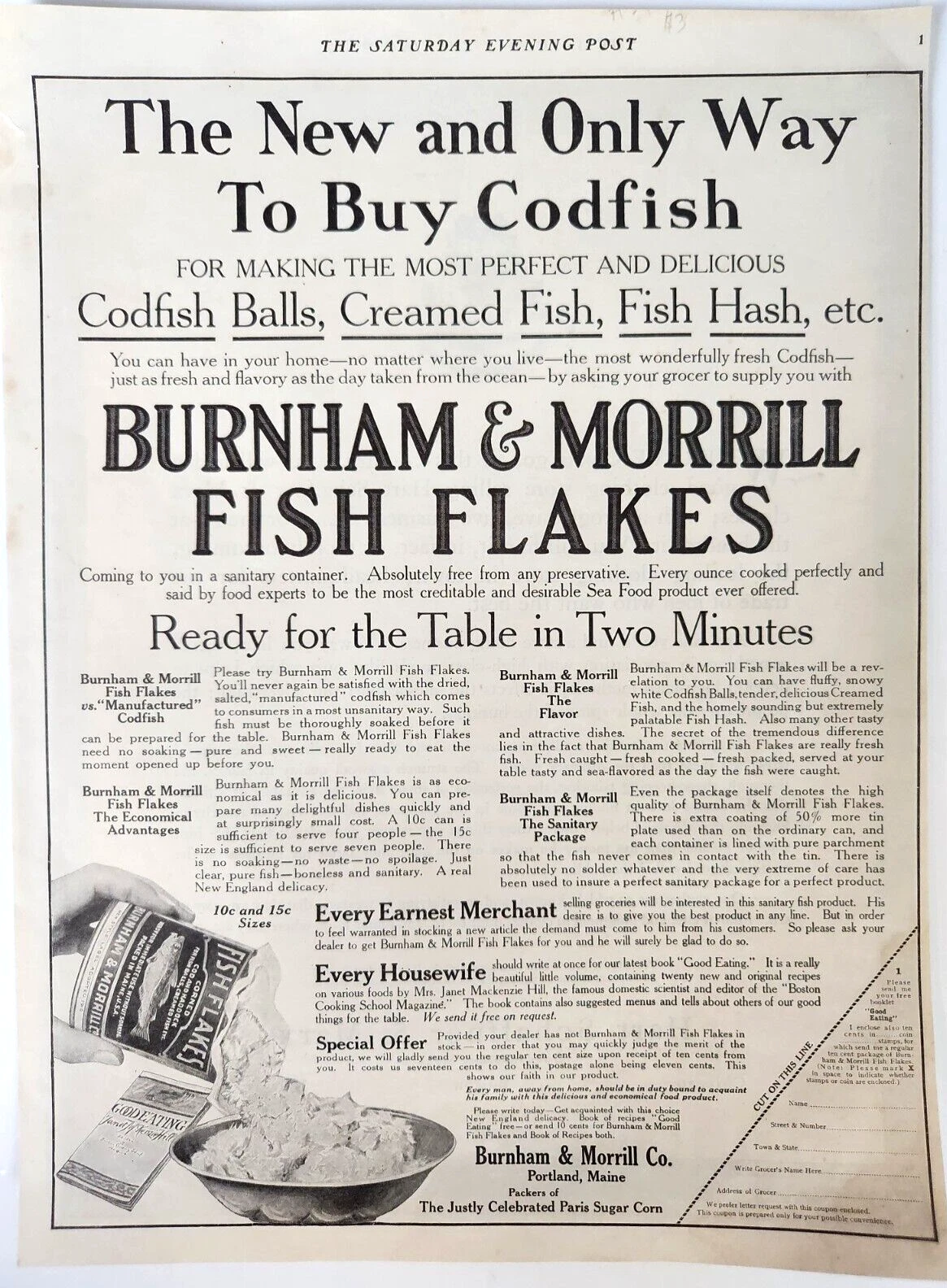
Fish Flakes were of a piece with the rest of the pre-beans product line: dried or salted staples, reinvented as something a home cook could open and use in minutes, sold on sanitation and convenience as much as taste. Roast beef, mutton, and turkey got the same treatment; so did the clams and lobster pulled from the Maine coast a few miles from the Franklin Street plant. The formula — take a New England kitchen staple, can it, and sell the time it saves — is the same one the company would eventually apply to baked beans, decades later and far more successfully than to codfish.
On August 6, 1859, Charles Sumner Morrill married Calista D. Dobbin. They had at least two children: Clara B. Morrill, born 1861, and George B. Morrill, born 1868. It was George who inherited his father’s stake in the firm after Charles Sumner’s death in 1901, bought out the Burnham family’s interest in 1910, and built the modern factory that would make Burnham & Morrill synonymous with baked beans for the rest of the twentieth century.
A Maine name that outlasted the family that gave it
The beans made the brand, and the brand outgrew the family fast. Burnham & Morrill passed out of Morrill hands entirely over the twentieth century: the William Underwood Company — the Massachusetts firm behind Underwood deviled ham — bought B&M in 1965. From there it passed to Piermont Foods of Montreal in 1968, to Pet Incorporated in 1982, to Pillsbury in 1995 (when Pillsbury acquired Pet), and finally to B&G Foods in 1999, as part of a $192 million purchase of six “Heritage” brands Pillsbury no longer considered central to its business. The Portland factory on Casco Bay ran for more than 150 years, its 200-pound iron cauldrons slow-baking beans on a ceiling-mounted rail system much as they had for generations, until B&G Foods closed it in 2021 and moved production to the Midwest. The can on the shelf still says B&M. The name on it is still, however distantly, a Morrill’s — a Portland tanner-turned-lumberman’s grandson who went into the canning trade with his old foreman, more than a century and a half ago.